For decades, the narrative surrounding aging has been one of inevitable decline. We’ve believed that as the candles on the birthday cake increase, our physical capabilities must naturally decrease. Within the last year, Westminster Communities of Florida launched a strength training program with residents of its Florida senior living communities, challenging that notion.
The objective was to prove that muscle loss is not a requirement of growing older, but rather a consequence of under-stimulation. By applying rigorous clinical standards to senior wellness programming, Vice President of Healthy Aging & Longevity Kelly Stranburg and her team saw results that are not just statistically significant, but life-changing for older adults.
This report summarizes three distinct pilot studies conducted across levels of living—Independent Living, Assisted Living, and Memory Care—demonstrating that with the right mindset and the right training, improvement is possible at any age.
The Science of Strength: A Global Standard
To ensure our findings were rooted in proven physiological principles, the programs were designed following the guidelines set by the American College of Sports Medicine (ACSM). The ACSM identifies resistance training as a cornerstone of healthy aging, essential for maintaining bone density, metabolic health, and functional independence.
According to the National Institute on Aging (NIA), age-related muscle loss, known as sarcopenia, is a primary driver of mobility decline and falls in older adults. However, research consistently shows that sarcopenia is reversible. Our pilot programs sought to apply these clinical insights within a residential setting, proving that high-quality, professional-grade fitness is not only safe for seniors but necessary.
Study 1: Independent Living and the Power of Pneumatics
In Independent Living, the focus is on high-level performance and “functional power.” While strength is the ability to lift a weight, power is the ability to move that weight quickly. Power is what allows a person to catch themselves during a trip or to rise quickly from a low chair.
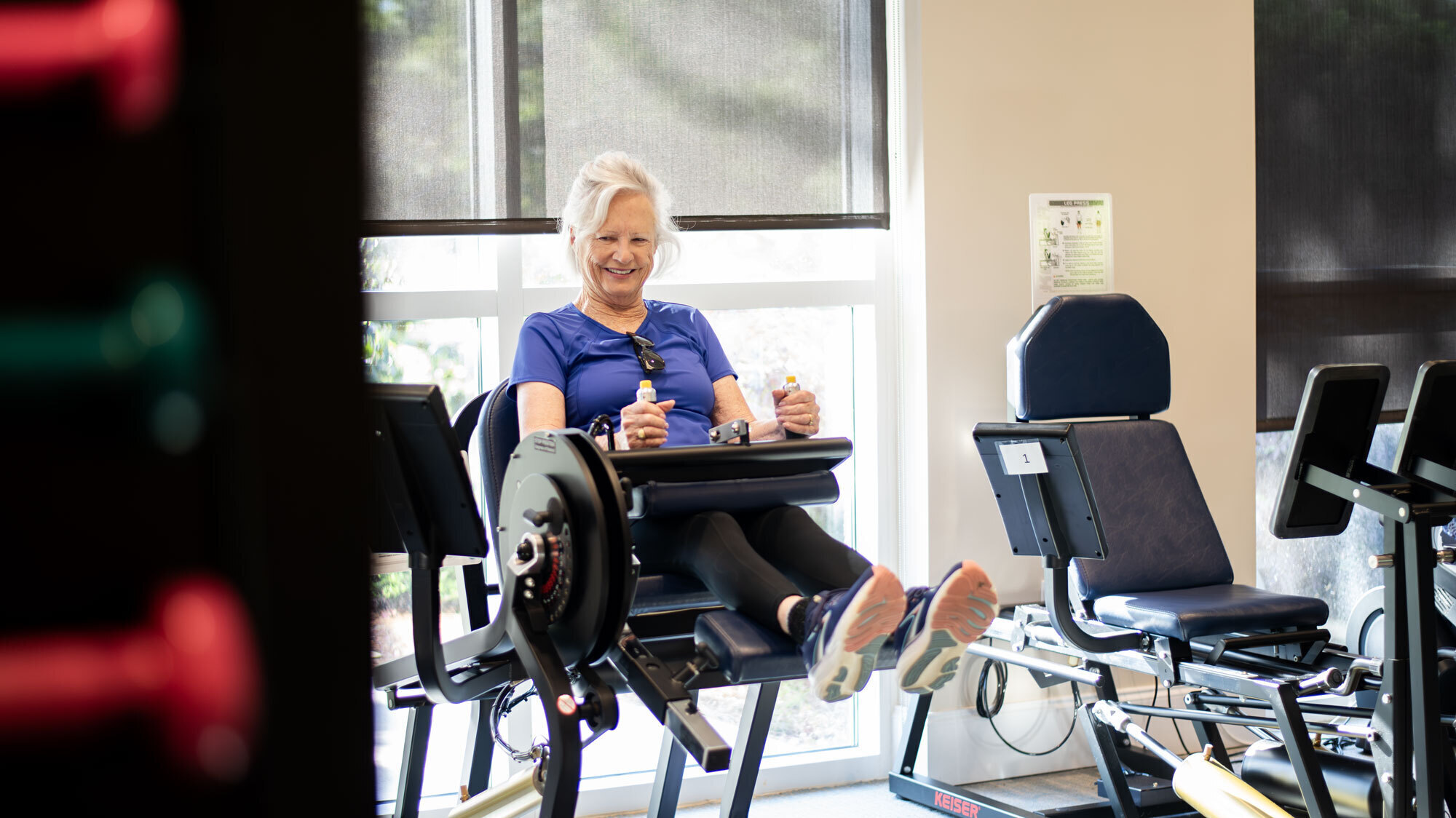
To address this, we partnered with Keiser, a world leader in pneumatic (air-pressure) resistance technology. Unlike traditional weights, pneumatic machines allow for high-speed training with zero impact on the joints, making them ideal for the aging athlete.
The Program: Keiser STEP
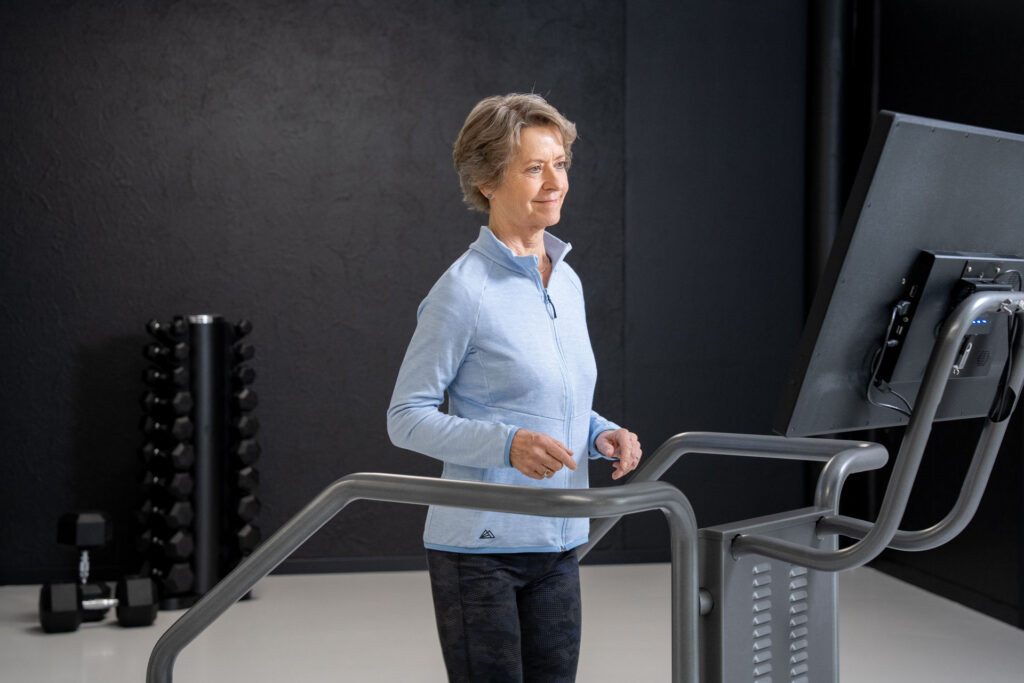
The Stronger Together, Empowering Performance (STEP) program brings cutting-edge Keiser strength equipment together with guided workouts and progress tracking. STEP focuses on power training (strength and speed), enhancing leg strength, gait speed, and sit-to-stand ability—critical for maintaining independence and reducing fall risk.
“Someone might be strong enough to catch themselves if they trip but are they quick enough to catch themselves?” posed Vice President of Healthy Aging & Longevity, Kelly Stranburg. “By incorporating the STEP program into our fitness offerings, we provide residents the opportunity to address facets of physical well-being like reaction time, walking speed, and overall balance.”
Westminster Oaks residents attended an education session conducted by STEP Director and Older Adult Market Specialist, Crystal Johnson. Following the session, 72 independent living residents signed up for the 12-week pilot program and baseline assessments were measured.
“Many threats to independence that older adults experience are not inevitable—they are completely trainable,” said Keiser STEP Director and Older Adult Market Specialist, Crystal Johnson. “The STEP program takes our world class equipment, along with our education and understanding of aging processes, to teach staff and residents how to harness the potential of the equipment and the potential that lives within each person.”
The Results
The data from the STEP pilot was staggering. Residents didn’t just feel better; their bodies functioned at a higher level across every metric:
- Five-Times Sit-to-Stand: This is a gold-standard measure of lower-body power and fall risk. Participants saw a 20.41% improvement. See Westminster Oaks Wellness Coordinator, Meredith Swaine, show perfect form when performing a sit-to-stand.
- Chest Press Power: Upper body explosive strength increased by 17.6%.
- Leg Press Power: Essential for stair climbing and walking, power in the legs increased by 11.05%.
- Gait Speed: Residents became 8.61% faster in their walking speed, a key indicator of longevity.
- Balance: Overall balance scores improved by 5.56%.
These gains represent the difference between a resident who walks with hesitation and one who moves with confidence and speed.
Watch resident testimonial videos
Study 2: Assisted Living – From “Protection” to “Progression”
In Assisted Living environments, the industry standard has often been “protection.” To avoid falls, exercise is frequently kept to seated positions. However, this creates a paradox: by keeping residents seated to protect them, we allow the very muscles required for standing to atrophy, thereby increasing the risk of a fall during daily transfers.
Our second pilot study, “Stand and Be Strong,” aimed to flip this script. At Westminster Palms in St. Petersburg, we replaced the traditional “Sit and Be Fit” model with a curriculum that prioritized standing exercises, weight-bearing, and progressive resistance.
The Mindset Shift
Renaming the class was a deliberate strategic move. “Stand and Be Strong” signaled to residents, families, and team members that we believed in the resilience of the human body, regardless of the level of support a resident might need for daily tasks.
The Results
After 12 weeks of meeting three times per week, Assisted Living residents—many of whom had previously been told to “take it easy”—showed remarkable physical resilience:
- Lower Body Strength: An aggregate improvement of 7.92%.
- Upper Body Strength: An aggregate improvement of 3.23%.
- Individual Milestones: One resident achieved an 80% increase in lower body strength. Most notably, a 100-year-old resident participated consistently, maintaining her lower body strength and improving her upper body strength by 30%.
These results prove that even in a centenarian, the body remains “plastic”—it can still learn, adapt, and grow stronger.
Study 3: Memory Care – Overcoming Cognitive Barriers
Perhaps the most significant findings came from our third pilot involving Memory support, “Memory Flex,” conducted at Westminster Baldwin Park. There is a common misconception that individuals with cognitive decline cannot follow the complex instructions required for resistance training. Our study proved that with specialized coaching and a structured environment, physical gains in Memory Care can outpace other levels of living.
The Program
The “Memory Flex” study utilized a 12-week protocol, meeting three times weekly. The focus was on repetitive, functional movements that mimic daily life, such as reaching and walking.
The Results
The improvements in dynamic balance were particularly impactful for this population, where fall prevention is a top priority:
- Functional Reach Test: This test measures how far a person can reach forward while maintaining a fixed base of support. The aggregate improvement was a massive 28.44%.
- Timed Up and Go (TUG): This measures the time it takes to stand, walk three meters, turn, and sit back down. Mobility and walking ability improved by 4.96%.
- Individual Highlights: One resident saw a 75% improvement in their reach, while another improved their TUG score by 64%.
For a resident in Memory Care, an extra few inches of reach or a faster walking speed means greater safety in their environment and a higher quality of life.
Organizational Impact: Why This Matters
For Westminster Communities of Florida, these three pilot studies represent more than just data points; they represent a fundamental shift in our organizational philosophy. We have moved from a model of “senior care” to one of “human potential.”
The Role of Sarcopenia and Fall Prevention
Falls are a leading cause of injury for older adults, often leading to a cascade of health complications. By focusing on strength and power, we are addressing the root cause of these incidents. When we increase a resident’s gait speed and balance, we are giving them the tools to remain independent.
Conclusion: See You in the Gym
What have we learned? We have learned that you can improve at any age. We have learned that strength training is not an “extra”—it is an essential component of healthcare. Most importantly, we have learned that when we set the bar higher, older adults will rise to meet it.
As we move forward, Westminster Communities of Florida will continue to integrate these evidence-based practices across our locations. We invite residents, their families, and team members to embrace this mindset of optimism and growth. Aging does not have to be a story of decline. It can be a story of strength.
We look forward to seeing you in the gym.
External Resources & Further Reading
- Learn more about the ACSM Guidelines for Strength Training in Older Adults.
- Discover the research behind Sarcopenia and Mobility from the National Institute on Aging.
- View the CDC’s STEADI Initiative for Fall Prevention.